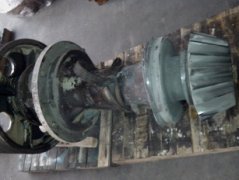
Why the main shaft deserves respect
Most crusher components wear; the main shaft is expected not to. It works under the full crushing load, cycles with every gyration, and anchors the head assembly through precision interfaces. When a shaft does fail — fatigue cracking, thread damage, a scored journal — the repair is never just a shaft: the head, bushings and seals that ran against it all need assessment. Our own repair record includes main frame work following a main shaft fracture on an HP500, which is the practical background behind this page: shaft enquiries here are handled as assembly questions, not as single-part transactions.
Shafts and assemblies supplied
The catalogue lists main shafts and main shaft assemblies for cone crushers as general catalogue lines — they are not recorded against the HP sizes, the GP series, Symons, the Metso family or the Sandvik family, so for a specific machine the shaft or assembly is confirmed against the model and original part number when quoted. An assembly suits the planned-rebuild route: the shaft arrives with its associated fitted components, the change-out is a swap rather than a strip-and-measure exercise, and the removed assembly can be inspected and rebuilt as the plant's spare. For repair-led orders — a damaged shaft on an otherwise sound machine — the single shaft is quoted against the model and part number, with mating-part condition discussed before the order is placed.
What to check before ordering
Before a shaft is ordered, three questions save money. First, what failed — a shaft that fractured may indicate a frame or load problem that a new shaft alone will meet again. Second, what is the condition of the head taper seat and the eccentric bushing bore, since a new shaft in a worn bore repeats the failure pattern. Third, are the threads and locking components (including locking bolts, which our repair work on head bodies has covered) serviceable or part of the order? Send photographs of the damage and the answers you have; the quotation will separate what must be replaced from what can honestly be kept.
Ordering and terms
Identification is by crusher model and original part number, confirmed before production or dispatch; where documentation is lost, dimensions from the removed shaft — overall length, journal diameters, thread specification — provide the identification route. Minimum order 1 piece, confirmed with your quotation. Lead time for machined components is confirmed per quotation and stated plainly; shipment on FOB, EXW, CIF or FCA terms, payment by T/T or L/C. Pair the shaft enquiry with the eccentric bushing and seal kit the job will disturb, and the crusher opens once instead of twice. The eccentric bushing and the seals named in this paragraph are general catalogue lines, not recorded against the HP sizes, the GP series, Symons, the Metso family or the Sandvik family.
| Parts | Main shafts; main shaft assemblies — general catalogue lines, not recorded against the HP sizes, the GP series, Symons, the Metso family or the Sandvik family |
|---|---|
| Identification | Model + part number, or dimensions from removed shaft |
| Related work | Head assemblies, frames, bushings, locking hardware — head assemblies and main frames are the recorded HP lines; bushings and locking hardware are general catalogue lines, not recorded against the HP sizes |
| Minimum order | 1 piece, confirmed with your quotation |
Records that protect the next shaft
When a shaft is replaced, the cheapest insurance for its successor is a failure record: photographs of the fracture or damage before cleaning, the position of any cracking relative to threads and journals, the condition of the head bore and bushing that ran against it, and the machine's recent event history — tramp incidents, setting excursions, oil problems. That record does two jobs. It lets the replacement be specified and its mating parts judged on evidence, and it tells the plant whether the cause was the shaft, the assembly, or the duty — the difference between a repair and a repeat. Our repair work on shaft and frame failures is handled this way as a matter of routine, and shaft enquiries that arrive with a failure record get a materially better answer than those that arrive with a part number alone. Both are welcome; the record is simply the version that protects the next decade of the machine's life.
Send us your part number or drawing
Quotes are prepared against your model, part number or dimension drawing. Minimum order is 1 piece on most catalogue parts — like the current lead time, it is confirmed with your quotation (typically within 15 workdays in peak season and about one month in the off-season). Contact Angela Ren of the Import & Export Department at the company sales email [email protected] or by mobile on +86 137 5230 3055.