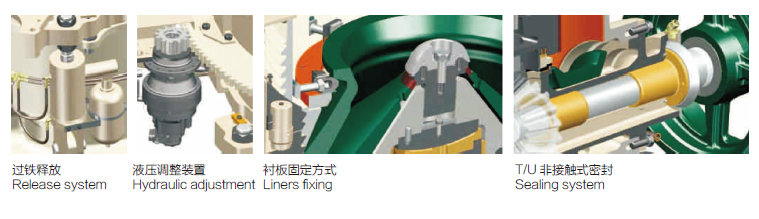
What the release cylinders do
On a multi-cylinder hydraulic cone crusher, a ring of hydraulic cylinders around the frame clamps the bowl assembly in its working position and holds the closed side setting. When a piece of tramp iron — a bucket tooth is the classic — enters the chamber and the crushing force spikes past the system's threshold, the cylinders yield: oil is displaced, the bowl lifts or tilts, and the iron passes through the discharge opening instead of being crushed against an immovable chamber. On our multi-cylinder machines the release works in both directions through dedicated tramp release hydraulic cylinders, with accumulators storing the energy that makes the release fast; once the iron is gone, the system reseats the bowl and crushing resumes at the set point. The cylinder ring is, in short, the hydraulic equivalent of the jaw crusher's sacrificial toggle plate — the designed weak point that keeps a tramp event a pause instead of a rebuild.
Why release condition decides frame life
A release system that is slow, weak or partially seized does not announce itself in normal crushing; it announces itself at the one moment it is needed. Tramp force that the cylinders fail to absorb travels into the frame, the bowl threads or clamping arrangement, and the liner seats — the most expensive structures in the machine. The warning signs are readable in advance: setting drift under load, a release event that does not reseat cleanly, oil temperature climbing, seals weeping at the cylinder glands, or pressure behaviour that has changed from the machine's own baseline. Those symptoms belong to the protection system, not the chamber, and they are the first place to look when a crusher mysteriously loses setting — a diagnostic order our repair services work follows as routine.
Supply and repair
Tramp release cylinders appear in the catalogue's parts spectrum as a listed component line. As a supply line they are a general catalogue line — not recorded against the HP sizes, the GP series, Symons, the Metso family or the Sandvik family — so a cylinder for a specific machine is identified against the crusher model and the original part number, with bore, stroke and mounting confirmed before production or dispatch. Separately from supply, our published technical support record includes release cylinder repair carried out on an HP500 machine (the head assembly and release cylinder repair entry): that is a service record evidencing repair work on the machine, not a supply record for this line, and cylinder supply for any machine — HP500 included — follows the general-line identification route above. Seals and accumulator components disturbed by a cylinder job are quoted on the same enquiry; the seals and accumulators named here are general catalogue lines under the same recorded position as the cylinders.
Ordering
Send the crusher model, the cylinder's original part number where it can be read, and a note of the symptoms if the order is failure-led — a release system that failed to release needs its mating components assessed, not just a new cylinder. Minimum order is 1 piece, confirmed with your quotation, as is the lead time; stock is checked against daily-updated inventory at quotation. Shipment on FOB, EXW, CIF or FCA terms; payment by T/T or L/C. Certificates available upon request.
| Part | Tramp release cylinder — a general catalogue line, not recorded against the HP sizes, the GP series, Symons, the Metso family or the Sandvik family |
|---|---|
| Function | Yields on tramp iron passage; reseats the bowl and restores the setting |
| Service evidence | Release cylinder repair on an HP500 in the published technical support record (service record, not a supply record) |
| Minimum order | 1 piece, confirmed with your quotation |
Send the cylinder’s part number — and the symptoms, if it failed to release
Give the crusher model, the cylinder’s original part number where it can be read, and bore, stroke and mounting where they can be measured; a release system that failed to release needs its mating components assessed, not just a new cylinder. Minimum order is 1 piece, confirmed with your quotation, as is the lead time (typically within 15 workdays in peak season and about one month in the off-season). Contact Angela Ren of the Import & Export Department at the company sales email [email protected] or by mobile on +86 137 5230 3055.