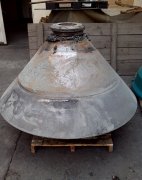
Two hydraulic platforms, one job
A cone crusher earns its place in the flowsheet by reducing hard rock reliably at a controlled top size. Our range is built on two hydraulic platforms. The single-cylinder hydraulic cone crusher uses one main hydraulic cylinder to support the main shaft, adjust the closed side setting and clear the chamber — a simpler structure with high crushing efficiency and low operating cost, well suited to secondary crushing of granite, basalt, river stone and ores. The multi-cylinder hydraulic cone crusher adds a ring of hydraulic cylinders around the frame for setting adjustment, tramp iron release and chamber clearing, and is the choice for fine and extra-fine duties where setting stability under load decides product gradation.
Lamination crushing, explained plainly
The multi-cylinder machines work on the lamination (inter-particle) crushing principle: the chamber is kept full, material is crushed against material as much as against the liners, and the combination of stroke and speed raises throughput at a given setting. In practice that means a higher proportion of product in the target fraction, better particle shape for concrete and asphalt aggregates, and wear spread across the chamber instead of concentrated on one liner zone. How the hydraulic systems behind the range — setting adjustment, tramp release and chamber clearing — work in detail is the subject of the hydraulic cone crushers page.
Built for maintenance crews
Wear parts can be dismantled from the top or the side of the machine, and the non-contact labyrinth seal keeps lubricating oil clean without the water sealing arrangements older designs needed. The crushers can be connected to a DCS automatic control system for plants that run centralised control rooms.
The systems behind the range
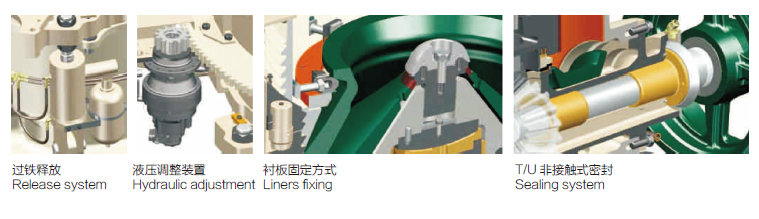
Section diagrams published with the equipment documentation show the systems that define the multi-cylinder design — tramp-iron release, hydraulic setting adjustment, liner fixing and the non-contact labyrinth sealing system.
Installation and commissioning
Multi-cylinder machines are supplied with support beyond the machine itself: technical consultation, system design, installation, commissioning, maintenance and operator training — the services that decide whether nameplate capacity shows up in production.
Choosing between single and multi-cylinder
Choose the single-cylinder platform when the duty is secondary crushing at moderate reduction, the budget is tight, and simplicity of the hydraulic system matters for remote sites. Choose the multi-cylinder platform when the plant sells graded aggregates, runs closed circuit with screens, or crushes abrasive feed where setting drift under tramp events costs saleable product. Either way, the wear parts programme behind the machine — mantles, concaves and mechanical spares — comes from the same factory, which keeps liner profiles and spares consistent over the machine's life. Talk to us about your feed size, target product and capacity, and we will recommend a configuration rather than simply a model number.
Delivered as a working station, not a crate
A cone crusher's first month decides its reputation on site. Our delivery scope is built to make that month boring: foundation and interface information supplied with the order, installation and commissioning support available from the same team that built the machine, and operator training that covers setting discipline, chamber management and the liner-change routine. The first wear set is specified with the machine — chamber profile and manganese grade matched to the feed the crusher will actually meet — and the critical spares list is agreed before shipment, not after the first breakdown. Plants that already run crushers from other manufacturers can adopt the same support pattern through the parts programme: one enquiry maps your installed machines against the catalogue, and the wear and spare supply follows the mapping.
Send us your part number or drawing
Quotes are prepared against your model, part number or dimension drawing. Minimum order is 1 piece on most catalogue parts — like the current lead time, it is confirmed with your quotation (typically within 15 workdays in peak season and about one month in the off-season). Contact Angela Ren of the Import & Export Department at the company sales email [email protected] or by mobile on +86 137 5230 3055.