Start with two paths
Every component in a cone crusher serves one of two paths. The load path carries crushing force: from the mantle into the head, the main shaft, the eccentric, the frame, and finally the foundation. The material path carries rock: feed plate, chamber, mantle and concave surfaces, discharge opening, out. Components that sit on both paths — the mantle above all — wear fastest and matter most. Reading the machine this way turns a parts list into a diagnosis tool: a symptom on the load path rarely has its cause on the material path, and vice versa.
Head and mantle: the moving crusher
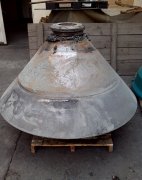
The head (also called the moving cone assembly) carries the mantle, the manganese wear surface that does the crushing. Driven in gyratory motion, the head approaches and retreats from the concave around the chamber, nipping rock at each pass. Head assemblies are complete catalogue units in our programme — recorded for HP-series machines, and not recorded against the GP series — because the head's seat condition decides whether a new mantle seats true. A mantle fitted on a damaged head seat rocks under load, and rocking manganese cracks: the assembly and the liner are one maintenance question, not two.
Bowl, concave and adjustment: the fixed crusher
The bowl carries the concave — fitted as the bowl liner — and in most designs the bowl's threaded or clamped connection to the frame is also the setting adjustment: rotate the bowl and the closed side setting changes. On our multi-cylinder hydraulic machines a hydraulic motor performs that rotation. Bowl and concave therefore decide both product size and product shape, and their condition is a quality issue before it is a wear issue: a worn concave profile silently rewrites the chamber geometry the plant believes it is running.
Main shaft: the spine
The main shaft carries the head, transmits the crushing load, and locates the whole moving assembly through its journals, tapers and threads. Shafts are supplied singly or as main shaft assemblies — general catalogue lines, not recorded against the HP sizes, the GP series, Symons, the Metso family or the Sandvik family — and our repair experience — including main frame work following a shaft fracture — teaches the respect this component deserves: when a shaft fails, every surface that ran against it (head bore, bushing, seals) must be assessed before the new shaft is committed, or the failure pattern repeats.
Eccentric and eccentric bushing: where gyration is born
The eccentric converts rotation into the head's gyratory stroke; the eccentric bushing is the bearing surface on which that motion runs under full load. Clearance here is destiny: too worn, and the shaft's motion becomes uncontrolled — vibration rises, oil temperature climbs, and the shaft journal scores. Bushing condition is best read indirectly between shutdowns (oil temperature trend, debris in return oil and filters) and directly at every liner change, when the check costs almost nothing.
Countershaft, pinion and gears: the drive train
Power enters through the countershaft: a horizontal shaft, carried in its countershaft box, whose pinion drives the large gear on the eccentric assembly. The HP200 gear in our catalogue is a forged component; the other listed gears, including the HP300 drive gear, carry the process their catalogue entry records, confirmed at quotation — because gear teeth under crushing shock loads punish the wrong manufacturing process. The coverage is narrower than the word "gears" suggests: the gears named here are recorded against the HP sizes, and gear lines are not recorded against the GP series. Drive-train symptoms (whine under load, backlash growth, metallic debris) point here, and gear enquiries should always state the mating component's condition: gears are replaced as a mesh, not as strangers.
Frame, counterweight and the rotating balance
The main frame absorbs everything the chamber generates; main frame assemblies are catalogue lines for the HP sizes and are not recorded against the GP series, while the upper frame line on record belongs to a GP-series machine (the GP220) and is not recorded against the HP sizes. The counterweight balances the gyratory mass of the head and eccentric — an unbalanced rotating assembly announces itself as vibration that no liner change will cure. Frame repairs, including the main frame work in our HP500 service record, are structural work: cracks are load-path information and deserve engineering assessment, not cosmetic welding.
Hydraulics, tramp release and seals: the protection system
The hydraulic system adjusts the setting, supports the shaft (in single-cylinder designs), clears packed chambers, and — through the tramp release cylinders — lets uncrushable iron pass instead of breaking the machine. Accumulators store the energy that makes release fast; valves, filters and seals keep the system honest. The non-contact labyrinth seals on our multi-cylinder machines protect the oil without water sealing. When a crusher 'mysteriously' loses setting or overheats its oil, this protection system — not the chamber — is the first place to look; our repair record on HP500 tramp release cylinders and horizontal shaft assemblies was built on exactly those symptoms.
Putting the tour to work
Diagnosis in a cone crusher is mostly component-relationship reasoning: chamber symptoms, check liner pair and setting system; load-path symptoms, check shaft, bushing and frame; drive symptoms, check the gear mesh. The spare parts programme is organised the same way — by component — so an enquiry that names the component and its symptom gets an answer that includes the mating parts to inspect. That is the working value of knowing the machine as a system of components rather than a list of prices.
Interfaces: where components actually fail
Ask a repair team where cone crushers fail and the honest answer is rarely 'inside a component' — it is at the interfaces between them. The mantle-to-head seat. The concave-to-bowl seat. The shaft-to-bushing bore. The gear mesh. Interfaces fail because they concentrate everything: load, motion, contamination and the consequences of the last assembly's workmanship. This is why so much of this site's advice reduces to interface discipline — seats cleaned and inspected at every liner change, mating parts assessed together before a replacement is committed, assemblies supplied complete where interfaces are internal and pre-set — complete assemblies in our programme follow the same record boundary as their parts: head assemblies are recorded for HP-series machines and not recorded against the GP series, and main shaft assemblies are general catalogue lines, not recorded against the HP sizes or the GP series. A plant that maintains its interfaces owns a crusher whose components live their design lives; a plant that treats components as independent consumables keeps buying good parts and fitting them into failing relationships. The components tour in this article is, in the end, a map of those relationships — learn the map, and the machine's behaviour stops being mysterious.
Keeping a component register
The practical companion to this tour is a component register: one page per crusher listing its major components, their part numbers, their installation dates and their condition at last inspection. It sounds like paperwork, and it is — the kind that converts a breakdown from an investigation into a lookup. When the register shows the eccentric bushing was last assessed two liner sets ago, the inspection plans itself; when it shows the head assembly is the machine's second, the spare-parts conversation changes. Our parts programme works directly from such registers: send the page for the machine in question and the enquiry is already half-specified. If your plant does not keep one, the next liner change is the perfect moment to start — the chamber is open, the components are visible, and the part numbers are, for once, readable. An hour spent then is repaid at the first breakdown that does not become a detective story.
Send us your part number or drawing
Quotes are prepared against your model, part number or dimension drawing. Minimum order is 1 piece on most catalogue parts — like the current lead time, it is confirmed with your quotation (typically within 15 workdays in peak season and about one month in the off-season). Contact Angela Ren of the Import & Export Department at the company sales email [email protected] or by mobile on +86 137 5230 3055.