Why this guide contains no price list
Start with a warning that protects your budget: a cone crusher price copied from a marketplace listing is rarely a price for the machine you need. Listings routinely quote a bare crusher in its smallest configuration, sometimes with a placeholder range spanning two orders of magnitude, while your plant needs a specific chamber, motor arrangement, hydraulic package and wear set. Comparing those numbers compares nothing. What can be compared — and what this guide gives you — is the structure of a real quotation, so that two genuine quotes for the same duty can be judged line by line.
Driver 1: Size, chamber and duty class
The largest single factor is the machine's size class and the chamber it runs. A cone crusher's price scales with the mass of steel in its frame, head and bowl, and with the installed power it is built to transmit. Chamber configuration matters twice: a machine specified for coarse secondary duty carries different liners, a different eccentric throw and often a different drive than the same frame in extra-fine short-head configuration. When a quotation looks unexpectedly cheap, the first question is which chamber and which duty the price actually describes.
Driver 2: The hydraulic package
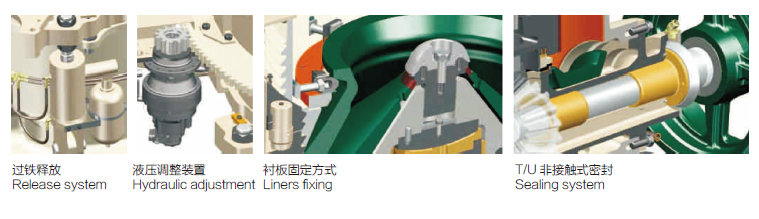
Modern cone crushers split by their hydraulic architecture. A single-cylinder hydraulic design concentrates setting adjustment, support and clearing in one main cylinder — simpler, and typically the lower-priced route to hydraulic control. A multi-cylinder design distributes those functions around the frame, adds hydraulic-motor setting rotation and dual-direction tramp release, and is built for fine duties where setting stability is itself a product-quality feature. Neither is 'better' in the abstract; the price difference buys defined capability, and the quotation should itemise it so you can decide whether your duty needs it.
Driver 3: Capacity claims and their conditions
Price per tonne of capacity is the comparison buyers actually want, which makes the conditions behind capacity figures a pricing issue. Reputable published figures state their basis — for our multi-cylinder range, a loose feed density of 1.6 t/m³ in open-circuit operation, with closed-circuit work typically raising capacity by 15%–30%. A quotation that promises capacity without stating feed density, circuit type and closed side setting is selling a number, not a machine. Ask for the conditions in writing; the discipline of the answer tells you as much as the figure.
Driver 4: The wear parts programme
Over a cone crusher's life, manganese wear parts — mantles and concaves — will cost a multiple of any plausible saving on the purchase price. Yet purchase comparisons routinely ignore them. The questions that belong in every machine evaluation: What does a matched mantle and concave set cost for this machine, in the grade my feed needs? What life, in tonnes, do comparable plants achieve? Is the minimum order one set, or must I stock a container of liners to get supply? A machine that is 10% cheaper and eats liners 30% faster is the expensive machine. Our wear parts programme exists precisely because cost per tonne, not price per piece, is the metric that survives contact with production.
Driver 5: Spares depth and downtime economics
The second lifetime cost is downtime waiting for mechanical spares. Two quotations for the same machine can hide very different realities: a supplier whose catalogue covers shafts, bushings, gears, frames and seals from one stock, versus one who brokers each part per breakdown. Check what the spare parts coverage actually is, what the minimum order is (ours is 1 piece on most lines, confirmed with your quotation), and what lead times look like in peak season — for common parts we quote within 15 workdays in peak season and around one month off-season, confirmed per order.
Driver 6: Scope — bare machine or working station?
Finally, scope. Does the price include the motor, the lubrication and hydraulic units, the control connection for your plant system, commissioning support and operator training? Our equipment offer includes technical consultation, system design, installation, commissioning, maintenance and training in its scope of services — and whether each item is inside or outside a given quotation should be explicit. Freight terms shift the number too: the same machine is four different prices on EXW, FOB, CIF and FCA terms, and honest quotations name the term next to the figure.
A fair-comparison checklist
Before deciding, line the quotations up against one duty statement — feed material and top size, target product and grading, required capacity, circuit type — and require every bidder to price that statement with: chamber and configuration named; hydraulic package itemised; capacity with its conditions; first wear set and critical spares priced separately; delivery term and lead time stated; and payment terms (in our case T/T or L/C) confirmed. The supplier who answers all six plainly is rarely the one who was cheapest in the marketplace listing — and is usually the cheapest over five years. When you are ready, the same checklist is the perfect enquiry: send it through our contact page and the quotation you receive will follow it line by line.
A worked way to read two quotations
Imagine two quotations for the same duty arrive a week apart. The first is a single attractive figure for 'cone crusher, complete'. The second is longer: machine in a named chamber configuration, hydraulic package itemised, first wear set priced separately with the manganese grade stated, critical spares listed, capacity stated at a declared feed density in open circuit, delivery term and lead time written down, training scope named. The second document is not more expensive because it is longer — it is more honest about what the first document left out. Every line the first quotation omits is a cost that will reappear later, usually at the least convenient moment and rarely at the quoted rate. Reading quotations this way — as disclosures, not as numbers — is the single habit that most improves crushing-plant purchasing. It also explains why this guide refused to open with a price: a price without its disclosure is the beginning of a negotiation you will lose slowly, in liner invoices and downtime, over the following five years.
Where geography enters the price
One last structural factor deserves honesty: where the machine is made and how it travels. A crusher is heavy, awkward freight; the delivery term in the quotation (EXW, FOB, CIF, FCA) decides how much of that journey is inside the number you are comparing. Two identical machines can differ substantially on delivered price purely on freight scope — which is why the checklist in this guide insists the term sit next to the figure. The same logic applies to parts over the machine's life: a wear programme supplied from one factory, consolidated into planned shipments, carries a freight cost per tonne of liners that emergency single-piece air shipments never will. Price, in other words, is partly a logistics decision — and logistics, unlike geology, is a decision entirely within the buyer's control. Make it deliberately, at quotation time, and the five-year arithmetic of the whole purchase improves before a single tonne is crushed.
Send us your part number or drawing
Quotes are prepared against your model, part number or dimension drawing. Minimum order is 1 piece on most catalogue parts — like the current lead time, it is confirmed with your quotation (typically within 15 workdays in peak season and about one month in the off-season). Contact Angela Ren of the Import & Export Department at the company sales email [email protected] or by mobile on +86 137 5230 3055.