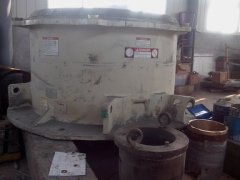
The crushing chamber: fixed jaw, swing jaw, jaw plates
Crushing happens between two jaw dies: the fixed jaw plate, mounted on the frame's front wall, and the swing jaw plate, mounted on the moving jaw (pitman). Their tooth profiles grip the feed, nip it at the top of the chamber, and let it fall deeper as the jaw opens — a repeated cycle that reduces rock in steps until it passes the discharge opening at the bottom. The plates are manganese steel wear parts, and their profile is a functional choice, not a cosmetic one: tooth pitch and height decide grip on slabby feed, chamber behaviour on fines, and how wear distributes. This is why our jaw plates are specified by duty rather than sold as a generic casting.
The pitman (moving jaw): the working arm
The pitman is the large moving component that carries the swing jaw plate. It is driven at its top by the eccentric shaft and guided at its bottom by the toggle mechanism, a combination that gives the jaw its elliptical motion — forward at the top to nip, and a discharge-assisting movement at the bottom. Pitman assemblies are a listed line in our parts programme because the pitman suffers when plates are run too long: once plate teeth are worn flat and wear breaks toward the plate back, the pitman face behind the plate becomes the wear surface, and a plate problem becomes an assembly problem.
The eccentric shaft and bearings: where motion begins
The eccentric shaft converts the motor's rotation into the pitman's stroke. It runs in heavy bearings at the frame, carries the flywheels that store energy between crushing strokes, and its eccentricity sets the throw of the jaw. Bearing condition is the quiet determinant of jaw crusher health: rising bearing temperature, changed lubrication condition or new vibration are early warnings that cost little to check and a great deal to ignore. In the parts catalogue, bearings sit alongside wedges, springs and hardware — small lines that belong in every planned shutdown kit.
The toggle plate and safety function
Behind the pitman's lower end, the toggle plate transmits motion from the eccentric's lower linkage and — critically — acts as the crusher's mechanical fuse. When an uncrushable object (a tooth from an excavator bucket is the classic) enters the chamber, the toggle plate is designed to fail first, sacrificing a replaceable component to protect the frame, shaft and pitman. A plant that 'upgrades' its toggle plate to something stronger has not improved its crusher; it has moved the failure somewhere far more expensive. Keep genuine-specification toggles on the shelf.
Cheek plates: guarding the frame walls
The chamber's side walls are lined with cheek plates. They take the lateral wear of rock moving down the chamber and protect the frame casting — a part you never want to wear. Cheek plates are easy to forget in ordering because they wear slowly, but a set worn through transfers abrasion into the frame seats, after which even new cheek plates no longer sit correctly. Include them in the chamber inspection whenever jaw plates are changed; they belong to the same wear system.
The adjustment system: setting the discharge
The discharge opening — and with it the product top size — is set by the adjustment mechanism at the toggle seat. Our jaw crushers use a double-wedge adjustment system: two opposed wedges move the toggle seat firmly and evenly, replacing shim stacks that corrode, vary in thickness and make setting changes a half-day job that crews avoid. Adjustment that is quick and firm gets used; adjustment that is neither is how a crusher ends up running a setting nobody chose. Wedges themselves are wear-and-corrosion items — they appear in our parts listings, and a seized adjustment system should be treated as a maintenance defect, not an operator inconvenience.
Flywheels, guards and the drive
The flywheels smooth the crushing cycle's violent power swings, storing energy on the open stroke and returning it on the nip. The drive — motor, belts and guards — deserves the same respect as the chamber: belt condition and alignment decide how much of the motor's power ever becomes crushing, and a slipping drive masquerades as a crusher capacity problem. When throughput drops, the disciplined sequence is chamber, setting, then drive — in that order.
How the parts wear together — and the maintenance order
The jaw crusher's components fail as a system: plates wear, settings drift, cheek plates thin, toggle seats fret, bearings age. The economical maintenance order follows the wear chain — inspect plates and cheeks together at plate change; check the adjustment wedges while the chamber is open; read bearing temperature trends between shutdowns; and keep one toggle plate and a set of small hardware on the shelf as insurance. Our jaw crusher parts page lists the supply programme behind this guide, with a minimum order of 1 piece, confirmed with your quotation, so the insurance shelf is cheap to keep complete. Send your model and the part you are looking at, and the identification starts from the component's function — the surest way to order the right part first time.
A note on part names — and why they cause wrong orders
Jaw crusher terminology carries a trap for the unwary: the same component answers to different names in different regions and manuals. The moving jaw is the pitman in one tradition and the jawstock in another; jaw plates appear as jaw dies; the swing plate is the movable jaw plate. None of this matters until an order is placed by name alone, at which point it matters completely. The defence is the same one used across this site: order by machine model and part number, and use the functional description as the cross-check — 'the plate carried on the moving jaw' identifies the swing plate in any terminology. When you send an enquiry to our jaw crusher parts programme, include the function in plain words alongside the number; if the two disagree, we will flag it before anything is cast, because a part identified two ways that agree is a part that fits.
The five-minute weekly inspection
Most of this guide's failure modes announce themselves to a five-minute weekly walk-around, and the routine is worth stating plainly. Listen to the crusher under load: a new knock or a changed rhythm is the toggle, the pitman or the drive asking for attention. Look at the chamber from the feed opening with the machine stopped and locked out: plate teeth condition, cheek plate edges, any rock packing that suggests a profile or feed change. Feel — with the back of a hand near, never on — the bearing housings for a temperature change against last week's memory, and check the oil or grease condition the lubrication system shows you. Glance at the adjustment wedges for movement marks that say the setting has crept. Five observations, none requiring instruments, and together they catch the jaw crusher's problems while they are still parts-sized rather than machine-sized. The plants that do this weekly rarely meet the failures this article describes; the ones that meet them can usually name the week the routine was skipped.
Send us your part number or drawing
Quotes are prepared against your model, part number or dimension drawing. Minimum order is 1 piece on most catalogue parts — like the current lead time, it is confirmed with your quotation (typically within 15 workdays in peak season and about one month in the off-season). Contact Angela Ren of the Import & Export Department at the company sales email [email protected] or by mobile on +86 137 5230 3055.